

Market Alignment | White Paper


When weak market alignment begins to damage sales productivity, customer satisfaction, and service profitability
A mid-sized Canadian company operating primarily in one province had grown from approximately $5 million in annual revenue to more than $25 million over a ten-year period. On the surface, it looked like a successful growth story. However, over the following three years, revenue began to decline in a troubling pattern: first by 5 percent, then 11 percent, and then 13 percent year over year.
Leadership knew the business was under pressure, but they had not fully diagnosed the source of the decline. What initially appeared to be a sales slowdown was, in fact, a broader Market Alignment issue that was beginning to affect the entire revenue system.
Through the Revenue Infrastructure Diagnostic, I reviewed the company’s market positioning, sales team performance, and the degree of alignment between sales, service, and marketing. That work made it clear that the company’s competitive position had shifted. Smaller, lower-cost competitors were gaining traction by undercutting price and taking share in the product category. At first glance, this looked like a straightforward competitive pricing problem. It was not.
The more serious issue was what happened after the sale.
The lower-cost competitors were winning initial transactions, but many of the products they sold required ongoing maintenance, warranty support, or service intervention. When those issues surfaced, customers often turned to the mid-sized incumbent for help. As a result, the company’s service department was repeatedly drawn into difficult, low-margin, and often unprofitable customer situations created by products it had not sold. These service interactions were frequently contentious, time-consuming, and operationally inefficient. In many cases, technicians felt pressured to discount the service heavily or waive charges altogether in order to preserve goodwill with the customer.
This meant the company was absorbing the downstream service burden while smaller competitors captured the higher-margin product sale and then effectively abandoned the customer.
That alone would have been serious enough. However, the diagnostic showed the issue was extending well beyond service.
Sales representatives were also being pulled into these accounts. Instead of focusing on profitable new customer acquisition and structured account development, they were spending a significant amount of time helping frustrated customers solve legacy product and service issues in the hope that doing so would eventually lead to future business. Leadership had been aware that some of this was occurring, but they had not appreciated the scale of the drag it was placing on the sales team.
The diagnostic found that this misalignment was reducing sales team effectiveness in new customer acquisition by an estimated 20 to 30 percent. It also contributed to a decline in current customer satisfaction of nearly 15 percent, as both sales and service resources were being diverted into reactive problem-solving rather than proactive revenue-generating activity.
From a Revenue Infrastructure Model perspective, the issue began in Market Alignment, but it did not stay there.
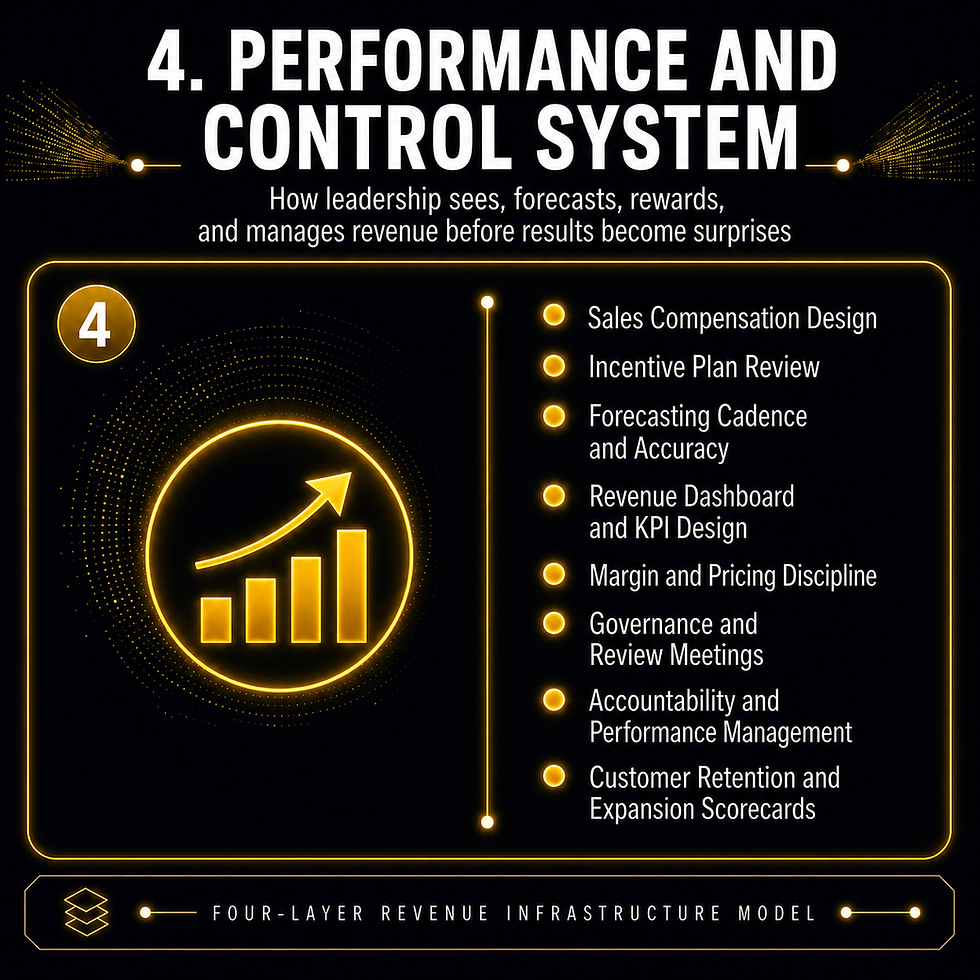
The company’s positioning had become vulnerable to low-cost competitors. That positioning weakness then created downstream strain in the Revenue Execution System, because salespeople were pulled away from structured prospecting and account development. It affected the Talent System, because valuable frontline people were being used in reactive, frustrating work that did not match their intended role. It also created problems in the Performance and Control System, because service discounting, wasted selling time, and distorted account effort were all undermining profitability and management visibility.
In other words, this was not simply a market problem. It was a revenue infrastructure problem.
The 360 Revenue Infrastructure Diagnostic Report identified this as a high-risk gap in Market Alignment with cascading effects across all four layers of the model. The issue was prioritized not only because it was contributing directly to declining sales, but because it was also eroding service profitability, damaging customer experience, and consuming scarce sales capacity that should have been directed toward profitable growth.
The value of the diagnostic was that it gave leadership a much clearer picture of where the decline was actually coming from. They had sensed the competitive threat at the outset of the engagement, but they had not yet connected that threat to reduced sales productivity, lower customer satisfaction, and service margin erosion.
This case is a useful example of why the four layers of the Revenue Infrastructure Model cannot be treated as separate service lines. A weakness in Market Alignment did not stay contained at the front end of the business. It spread into execution, talent utilization, and performance control. Once that was visible, leadership could begin to prioritize the right corrective actions based on both commercial impact and management time.
Why this example matters
This is the kind of issue that often looks, at first, like “sales are down” or “competition is getting tougher.” In reality, the deeper problem is that the company’s market position is no longer aligned with how revenue is being generated, defended, and serviced. When that happens, the organization begins to lose effectiveness across multiple parts of the revenue system at the same time.


Comments