

Revenue Execution System | White Paper
- Paul Kidston

- May 3
- 4 min read

When a company’s sales approach no longer reflects how customers actually buy
A mid-sized Canadian manufacturer of data storage devices had built a strong business through six consecutive years of progressive growth in both Canada and the United States. The company had grown through persistence, product knowledge, and a small sales team that worked hard and understood the offering well. On the surface, there was no obvious failure in effort or commitment. The team was capable, disciplined, and commercially serious.
Yet over time, leadership began to see a concerning pattern. Sales were still growing, but at a slower rate each year. Growth had not stopped, but it was clearly losing momentum.
This slowdown was particularly troubling because the broader market indicators suggested the opposite should have been happening. Internationally, the product category remained in growth mode. Demand fundamentals were still favorable. However, the competitive environment had become more complex. Larger competitors were differentiating themselves through value-added technical services, while smaller competitors were undercutting on price. The mid-sized company was caught in the middle: too sophisticated to compete on price alone, but not yet fully aligned around a sales execution model that matched how enterprise buyers actually wanted to buy.
A Revenue Infrastructure Diagnostic was completed to identify the capability gaps that were constraining performance. The most significant finding was not a product issue, nor a market demand issue, nor a weakness in effort from the sales team. The largest gap was in the company’s Revenue Execution System, specifically its Sales Playbook.
The existing sales approach was still rooted in a traditional seller-centric model. The sales team worked hard to identify the right technical buyers, but once they found them, they struggled to gain traction. Phone calls were rarely returned. Initial outreach often went nowhere. Even when the technical buyer was reached, the conversations frequently stalled because that individual would explain that while they were consulted, they were not the final purchasing decision-maker.
As a result, new customer acquisition became increasingly difficult.
This was a critical insight. The issue was not simply access. The issue was that the company was trying to sell the product based on how it wanted to sell, rather than how the customer preferred to buy.
That distinction became the turning point in the diagnostic.
After reviewing the existing Sales Playbook, I reframed the core question for leadership and the sales team:
“How do customers like to buy our product?”
That question replaced the company’s implicit existing mindset, which had been:
“How do we sell this product?”
That shift changed the entire direction of the sales execution model.
To validate the new thinking, outreach was made to several strong existing customers. Those conversations made it clear that the correct model for this offering was enterprise selling, not conventional product pitching. The people the company had been trying to reach did not want general sales language, perceived business benefits, or persuasive product talk. They wanted highly relevant technical information. They cared about product specifications, compatibility with their current technology stack, implementation fit, service implications, and the operational consequences of choosing a new supplier.
In short, they did not want to be sold in the traditional sense. They wanted to evaluate.
That insight had major implications for the Revenue Execution System.
The company redesigned its playbook around the buying behavior of the technical buyer and the broader enterprise buying environment. It became clear that technical buyers responded much more positively to educational content than to standard outreach. In particular, they preferred short-form video explanations that focused on technical specifications, integration issues, use-case relevance, and the practical support implications of the product. These assets also allowed the company to present some of the value-added service considerations that larger competitors were using as part of their own positioning.
In response, the company launched a series of virtual lunch-and-learn sessions for technical buyers. The material from those sessions was then repurposed into video assets for the sales team to use in targeted email campaigns.
The impact was immediate and measurable.
Email open rates rose to more than 70 percent, and successful initial contact with technical buyers increased by 50 percent. More importantly, those contacts were more productive, because they were built around the information buyers actually wanted, rather than around generic seller messaging that had previously failed to resonate.
From a Revenue Infrastructure Model perspective, this issue sat most visibly in the Revenue Execution System, but it did not remain isolated there.
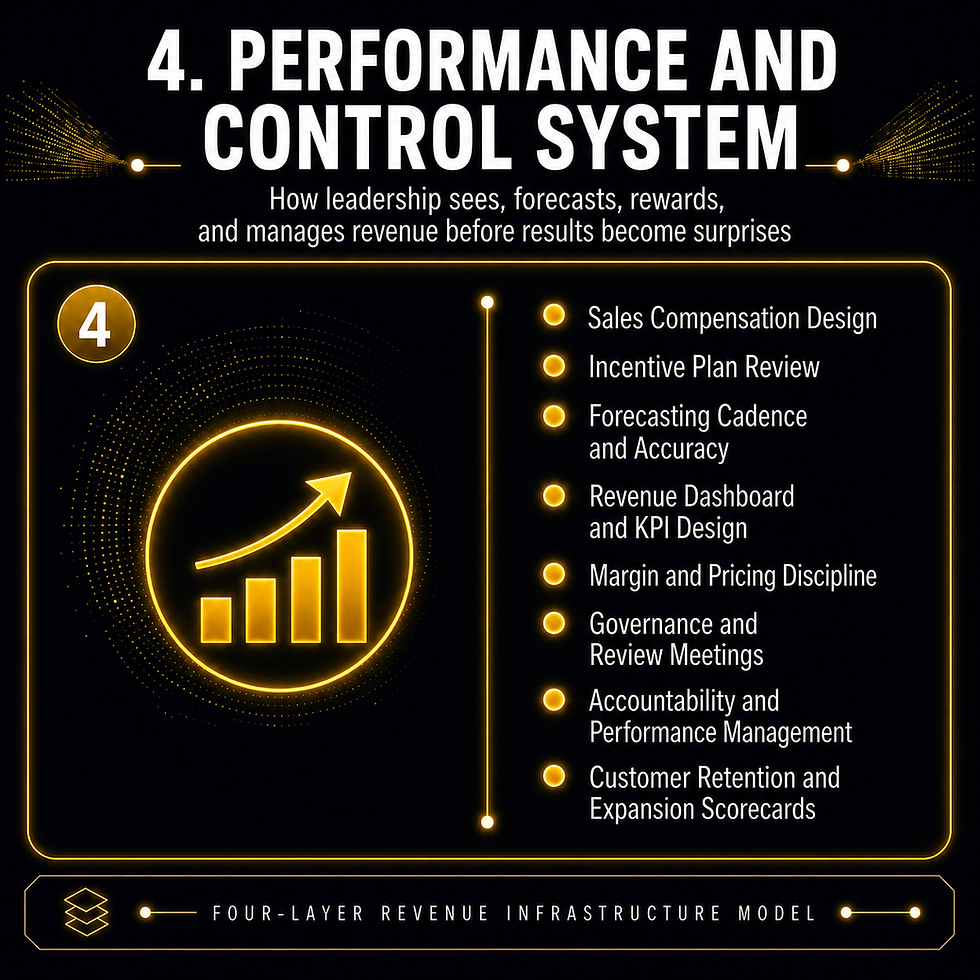
The original Sales Playbook had been built around a seller-centric process instead of a buyer-aligned one. That weakened the company’s ability to create momentum in new account acquisition. It also created strain in Market Alignment, because the company’s message was not sufficiently tuned to the practical concerns of the technical buyer. It affected the Talent System, because capable salespeople were using the wrong commercial tools and therefore not getting the full return on their effort. It also had implications for the Performance and Control System, because management could see slowing growth but did not yet have the right diagnostic lens to identify whether the issue was people, market, message, or process.
The 360 Revenue Infrastructure Diagnostic Report identified the Sales Playbook gap as a high-priority execution issue because it was directly limiting growth in a market that still had favorable demand conditions. The problem was not that the company lacked a strong product or committed people. The problem was that its revenue execution model had not evolved with the complexity of the buying environment.
This case illustrates an important principle: when growth slows in a healthy market, the issue is often not demand itself. It is often that the company’s selling system is no longer aligned with how the customer makes buying decisions.
In this case, once leadership stopped asking how to sell the product and started asking how customers preferred to buy it, the company was able to improve access, create better first conversations, and restore momentum in new customer development.
Why this example matters
This is a useful example of why the Revenue Execution System cannot be reduced to sales effort, activity volume, or general selling ability. A capable sales team can still underperform if the Sales Playbook does not reflect the actual buying process. When that happens, the organization may wrongly assume the problem is sales talent, when in fact the deeper issue is execution design.


Comments