

Talent System | White Paper


When a mature market turns sales talent into the central revenue risk
A large telecommunications retailer operating across Canada had grown with the industry over more than two decades. In the earlier stages of market expansion, the commercial model was straightforward: the priority was customer acquisition. As smartphone adoption accelerated and the market expanded, almost every new subscriber represented fresh growth. Sales teams were central to that expansion, and strong performers could produce exceptional value for the business.
Over time, however, the industry matured. The growth dynamics changed. Fewer entirely new customers were entering the market, and a much greater share of selling activity shifted toward converting customers away from competitors. In that environment, churn became both an opportunity and a threat. Every customer with a smartphone remained a potential customer, but every existing customer in the retailer’s own base also became a target for competitors.
This dynamic had major implications for the company’s economics.
Selling the handset or device was only one part of the profitability picture. The more valuable piece was the stream of monthly residual payments generated through the large telecommunications brands represented by the retailer. In other words, the long-term value of the customer relationship mattered more than the initial transaction itself.
As the industry matured, however, several forces began to weaken the retailer’s talent position.
First, experienced sales representatives became more difficult to recruit and retain. Over time, many of the stronger reps came to understand their own market value. They knew they could move between employers, and in some cases bring meaningful enterprise customer relationships with them. That made top performers both highly valuable internally and increasingly vulnerable to competitive poaching.
Second, industry pricing pressure intensified. To win conversions from competitors, retailers were often required to acquire customers at increasingly discounted rates. That reduced the long-term economic value of each new customer and put downward pressure on rep compensation. The result was a difficult cycle: as the financial value of the customer declined, compensation became less attractive, and turnover increased.
Leadership recognized the problem clearly. They knew compensation was under pressure, but they also knew they could not simply solve the issue by paying more. The question was whether there was another way to reduce turnover, improve employee satisfaction, and strengthen the long-term quality of the sales force without materially increasing compensation.
That question led to a Revenue Infrastructure Diagnostic.
The diagnostic confirmed that the primary issue was not simply compensation design in isolation. The more fundamental problem sat in the Talent System. The company had not yet built a sufficiently disciplined way to identify, select, and hire the types of salespeople most likely to succeed and remain engaged in that specific retail environment.
This mattered because in a mature, highly competitive market, not every capable seller is the right fit. Some salespeople are attracted to short-cycle acquisition environments, others to consultative selling, and others to relationship-based account development. Without a clear talent benchmark, the organization was relying too heavily on conventional hiring judgment and prior sales experience, which was producing too much variation in fit, resilience, and long-term retention.
To address that, I reviewed the company’s turnover patterns and the direct and indirect cost of attrition. That included the cost of recruitment, onboarding, disruption to store performance, lost productivity, and the management burden created by repeated replacement cycles. From there, a social science assessment tool was deployed that measured 21 work-related behaviors and attributes across a representative sample of the company’s top 20 percent of sales performers.
This step was critical.
Rather than relying on abstract hiring assumptions, the company now had the opportunity to identify the actual behavioral profile of its highest-performing and most durable sales talent. Once a sufficiently large and representative sample had been completed, those results were used to establish specific role benchmarks. Those benchmarks were then built into a profiling tool and integrated directly into the company’s applicant tracking system.
The effect was to make the Talent System far more precise.
Instead of simply hiring people who looked good in interviews or had prior telecom sales experience, the organization could now screen for best fit based on the patterns demonstrated by its own strongest performers. Over time, this improved the consistency and quality of hiring decisions.
The results improved month over month and year over year. Quality of hire increased, hiring fit improved, and sales representative turnover declined significantly.
From a Revenue Infrastructure Model standpoint, this was fundamentally a Talent System issue, but the consequences of the gap were far broader.
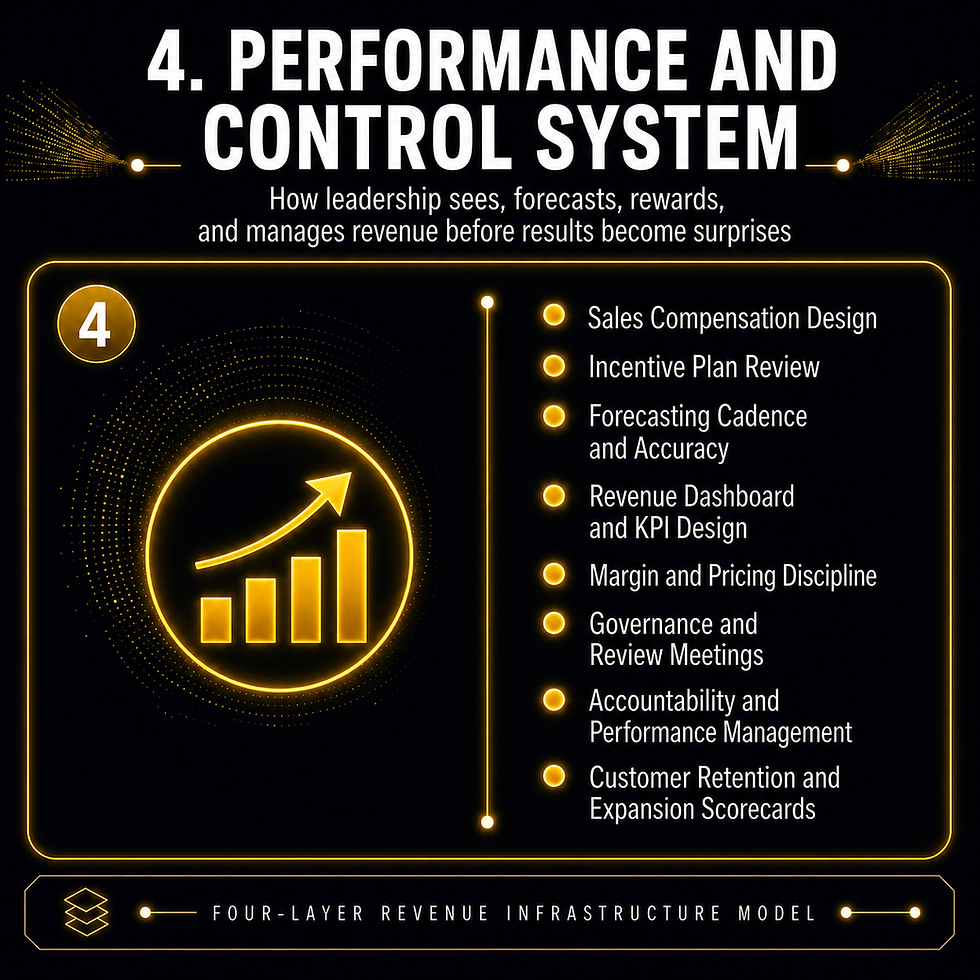
Weak talent fit affected the Revenue Execution System, because high turnover disrupted continuity, reduced experience on the floor, and weakened the consistency of customer acquisition and conversion efforts. It affected Performance and Control Systems, because turnover created instability in productivity, forecasting, store-level accountability, and manager time allocation. It also had implications for Market Alignment, because in a mature market the company needed salespeople who were behaviorally aligned not just with the product, but with the realities of a highly competitive retention and conversion environment.
In other words, the problem was not simply that employees were leaving. The problem was that the company’s talent infrastructure had not evolved with the maturity of the market.
The 360 Revenue Infrastructure Diagnostic Report identified this Talent System gap as a high-priority issue because it was creating recurring revenue drag, avoidable hiring costs, and operational instability in a market where talent quality had become one of the few remaining controllable competitive advantages.
This case illustrates an important principle: when compensation flexibility is limited, companies often assume there are few levers left to pull. In reality, a disciplined Talent System can materially improve performance even when pay cannot be increased. By improving hiring precision, the organization was able to reduce turnover, improve employee fit, and strengthen the commercial consistency of the business without relying on compensation alone.
Why this example matters
This is a strong example of why the Talent System is not just a human resources issue. In the right revenue model, talent fit is a commercial issue. When hiring quality, role fit, and retention begin to erode, the effects show up in customer acquisition, customer retention, management burden, productivity, and ultimately revenue performance itself.


Comments